We’ve all had that horrendous feeling when your heart sinks to your shoes because you’ve noticed a typo and it’s too late, writes Sarah Newton.
I’m not talking about the kind you might make in a rushed WhatsApp message or an email you bashed out and sent before reading – but the big, bold, printed-and-paid-for kind.
The kind that has made it through drafts, approvals, designers, printers… and still proudly stands there for the world to see.
Take, for example, a rather grand sign at Chatsworth. A beautiful setting, rolling countryside, a sense of heritage… and then: “Chastworth Family Festivial.”
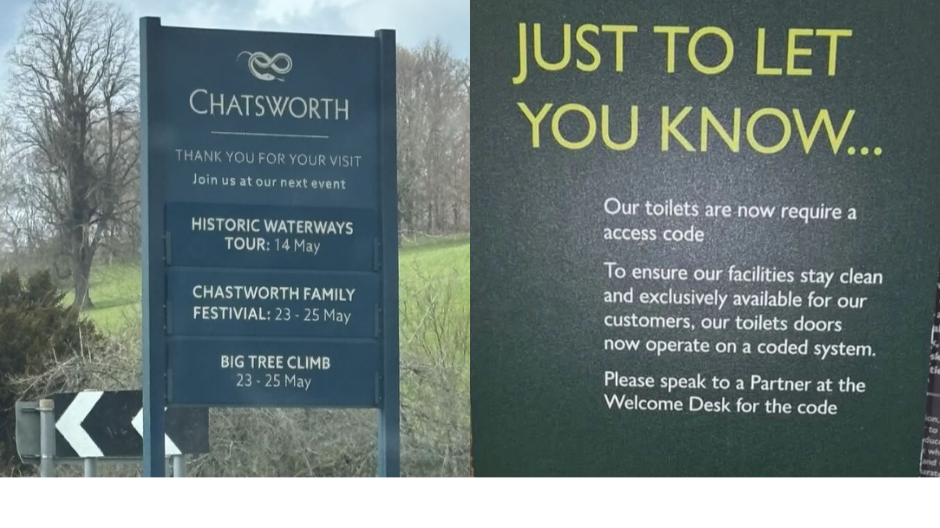
You can almost picture the moment it was spotted – probably by a visitor, rather than anyone involved in creating it. Because that’s the thing about typos: they’re invisible until they’re suddenly very visible. And then it’s impossible to imagine how you didn’t see it before.
This sign offers a two for the price of one deal that you would be unlikely to find in the Farm Shop. Not only do we get “Chastworth,” but also the bonus “Festivial” – a word that sounds like it could actually be quite fun, if only it existed.
But Chatsworth’s marketing team aren’t the only ones kicking themselves. The equally upmarket Waitrose – which almost certainly delivers to Chatsworth when the Duke and Duchess do an online shop – has also had a stinker.
This sign at a store in Peterborough has more mistakes than the store has middle class shoppers. It starts with: “Our toilets are now require a access code.”
It continues: “To ensure our facilities stay clean and exclusively available for our customers, our toilets doors now operate on a coded system. Please speak to a Partner at the Welcome Desk for the code”
Again, it’s not the end of the world. Nobody’s storming out. The toilets still function. Life goes on.
But these tiny slips do something disproportionate to their size. They chip away, just slightly, at perception.
Because brands – whether it’s a stately home or a supermarket – are built on trust, attention to detail and polish. And when something as visible as signage gets it wrong, it creates a tiny moment of doubt: If this wasn’t checked… what else wasn’t?
It’s unfair, of course. Humans make mistakes. Everyone does. In fact, that’s kind of the point – these signs are oddly endearing because they remind us that behind every “brand” are actual people, probably juggling deadlines, emails and someone asking where the stapler’s gone.
But in communications – especially public-facing ones – the small things matter more than we think.
A typo isn’t just a typo when it’s on a sign, a website, or a campaign. It becomes part of the experience. Part of the brand. It sticks in people’s minds – sometimes longer than the message itself.
And in a world where audiences are constantly scanning, judging and forming snap impressions, those small details often carry more weight than the bigger picture we spent weeks perfecting. You might remember the typo long after you’ve forgotten what the sign was actually advertising.
That’s why the final stages – the proofreading, the second pair of eyes, the “just one more check” – matter so much. Not because perfection is realistic (it isn’t), but because care is visible. Effort shows and people notice.
Of course, even with the best processes in place, things will occasionally slip through. A rogue letter, a word that spellcheck politely ignored. When they do, the best response is usually a mix of humility and humour – fix it if you can, own it if you can’t, and move on.
But there’s another layer to all of this now. Today, these mistakes don’t just sit on a sign or a shelf. They get photographed, posted, shared, screenshotted and shared again. A small slip spotted by one person can become a minor internet celebrity within hours.
Even when it’s been corrected in the real world, it continues to live on online – doing the rounds long after the physical evidence has been taken down or fixed.
In some cases, more people will see the mistake on social media than ever saw the original sign in situ. What was once a fleeting, local error becomes a lasting, widely shared moment – often divorced from context, but firmly attached to the brand name. The typo might be gone, but its digital afterlife is just getting started.
And then there’s a newer, slightly baffling twist: the idea that mistakes might be deliberate. That sprinkling in a typo or two somehow signals authenticity – proof that something was created by a human, not AI.
It’s a nice theory. It’s also, frankly, a bit ridiculous. Nobody has ever looked at a sign that reads “toilets are now require a access code” and thought, ‘Ah yes, reassuringly human’. Deliberately introducing errors isn’t a clever signal of humanity – it’s just… an error.
And ironically, in trying to prove something is human, you risk making the brand look careless instead.
Which brings us neatly back to the original point: mistakes happen, and when they do, they’re usually forgiven. But choosing to make them? That’s a whole different story.
Still, if there’s one takeaway from “Festivial” and coded toilet doors, it’s this: never underestimate the power of a fresh set of eyes… preferably before anything is published or it goes to pinrt.
Want to make sure your brand never gets caught out? Penguin PR can help you spot what others miss.