The first time I walked into the Royal School for the Deaf Derby, I was mortified to realise that the very best I could offer in terms of communication was an enthusiastic – but entirely inadequate – thumbs up, writes Sarah Newton.
There I was – someone who works in communications, no less – smiling enthusiastically, nodding along and contributing absolutely nothing useful beyond an over-reliance on nodding. Not ideal.
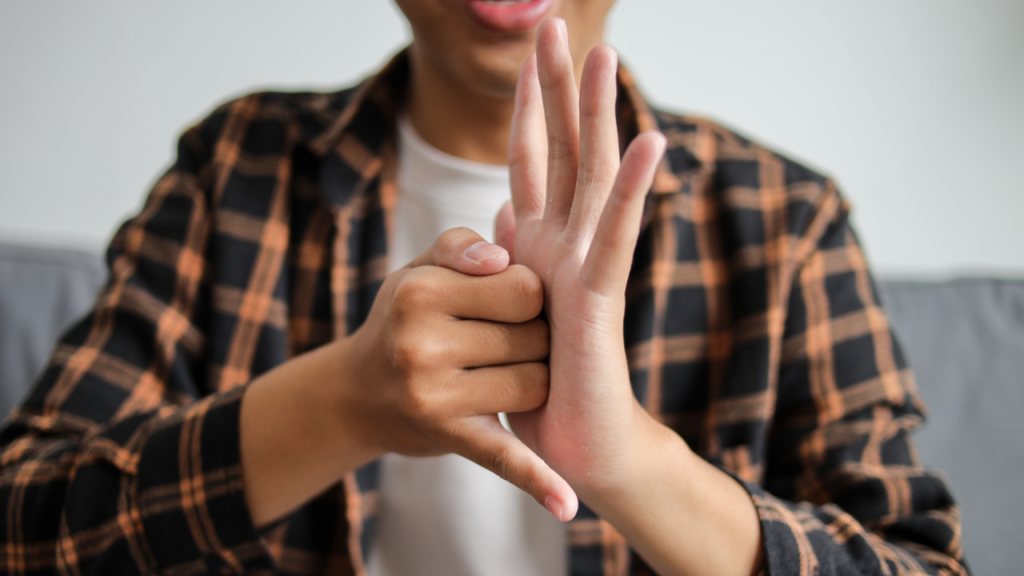
And it really struck me that this brief, uncomfortable feeling of not being able to communicate -even in a supportive environment – must be what many deaf people experience every single day in the wider world. That sense of being present but not fully included, of wanting to engage but not quite having the tools to do so, stayed with me.
So, I signed up for BSL classes and, rather optimistically, assumed I might have a head start – after all, I was once told off by a teacher for having my thoughts written all over my face.
How hard could it be?
Well.
My experience learning BSL
It turns out my hands are not the natural communicators I assumed they were. What looks smooth and expressive when someone fluent signs turns into something between charades and a mild medical episode when I attempt it.
I’m fairly sure that on more than one occasion I’ve confidently signed something about transport, only to accidentally ask a deeply confusing question about pink potatoes.
And then there’s the face. No one tells you that BSL is essentially acting. You need the right expression, the right emphasis – eyebrows doing half the work, apparently.
But despite all of that – I absolutely love it. Like anyone learning a new language, my conversational range is currently fairly limited: I can confidently discuss transport options, list countries of the world, introduce my family, and talk at surprising length about food – including potatoes – and colours.
Which is great, of course, unless the conversation requires anything remotely complex, at which point I’m back to enthusiastic nodding and hoping “train,” “blue,” and “chips” will somehow carry me through.
Derby’s unique deaf heritage
But even with that limited vocabulary, something shifts. The deaf children – and staff – at the school may not have a clue what I’m trying to say but they can at least see I’m making an effort. And in a city which is home to the largest deaf population outside of London that should be something we can all say.
You might imagine that Derby would be bilingual – with British Sign Language in abundant use every day and signage reflecting a shared visual and spoken language culture.
We might expect to see BSL interpreters present at all public events, BSL translations on official signs and public information boards, and everyday communication enriched by gestures and signs as natural parts of the city’s landscape.
But despite the school’s long-standing presence and its deep-rooted legacy in the city, BSL is still not widely seen or understood in public life and deaf culture remains on the margins.
There is definitely a concerted effort to change this, with people such as leading deaf historian Wendy Daunt and Paul Burrows, head teacher of today’s Royal School for the Deaf Derby, working hard to ensure that the past is honoured by creating a more inclusive present.
Take the first step this National Sign Language Week
So, since it is National Sign Language Week, instead of saying how much you might like to learn BSL, why not take the first step and actually begin?
There are now more opportunities than ever in Derby to access BSL classes or to simply start learning a few basic signs to bridge the communication gap.
Learning even a handful of signs can make a world of difference to a deaf person navigating a hearing world – it shows respect, builds connection and chips away at the silence that too often surrounds deaf lives.
It also helps foster a sense of belonging, where deaf and hearing people can share the same spaces with equal voice, whether that voice is spoken or signed.
How learning BSL improves inclusion
In a city with such a profound connection to deaf history, it’s time we reflect that legacy not only in museums or plaques, but in the way we live and communicate today. True inclusion means action and a more bilingual, visually rich Derby isn’t just a dream. It’s something each of us can help shape – one sign at a time.
Even my limited knowledge has opened doors I never expected. A smile of recognition from a deaf person when I sign “how are you?” is worth more than words can say. It’s a small gesture, but it carries weight – it shows effort and a willingness to meet someone in their world, rather than expecting them to navigate ours.
BSL is also incredibly fun to learn. It’s expressive, physical and a language that uses your whole body, not just your voice. There’s a joy in discovering how to convey meaning through movement and facial expression and a real sense of connection when you get it right. It engages your mind in new ways, sharpening your observation skills and encouraging you to truly watch people, not just hear them.
Learning basic BSL has made me realise how easy it is to be inclusive once you start paying attention – how a signed announcement, a BSL interpreter on stage, or even just fingerspelling a name can turn exclusion into belonging.
So, if you’ve ever found yourself curious about BSL, don’t wait for the “right time”. Start now. Join a class, watch a video, learn the alphabet. Every sign you learn is a step toward a more inclusive Derby and a richer, more connected life.
Inclusion doesn’t begin with policy or signage – it begins with people. And in a city like Derby, with its deep and proud ties to deaf education, each of us has the chance, and the responsibility, to make that legacy visible in how we live, listen and sign today.
I’m still very much at the stage where I look like I’m enthusiastically miming my way through life, but I’m getting there. And hopefully next time I walk into the Royal School for the Deaf, I’ll be able to do more than just smile and panic.
Even if I do still occasionally ask where the potato is.