Most people from Derby will recognise the green cast iron box, with its gold embossed stag, which stands on the pavement of Friar Gate, writes Sarah Newton.
Some will know that it is a transformer box which once supplied electricity to the trams which ran up and down Ashbourne Road.
But for a handful of deaf people the box has a very poignant and emotional significance. For it stood opposite the original home of the Royal School for the Deaf Derby and was the place where parents waited in the hope of catching a brief glimpse of their children.
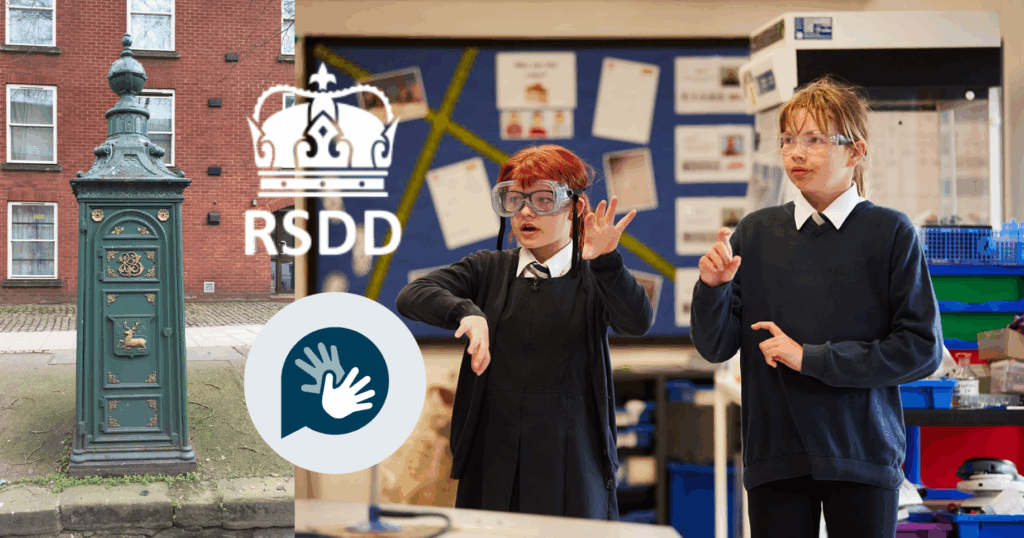
For parents were not allowed to visit their offspring, who were allowed home only three times a year, unless there were very special circumstances. So, pupils would stand at the window and wave to their parents, a moment in time too heart-wrenching to imagine.
Many of these students had no idea they were to be left at the school until they arrived at its enormous and imposing entrance. And once inside the ornate doors they found themselves in a stately reception area filled with stuffed birds in glass cases.
Long-lasting legacy
This daunting introduction to education must have been terrifying at the time and a million miles from the vibrant, happy school of today – a place where children are listened to, can express their views and be understood.
But the long lasting legacy of the school – founded in 1898 – is that Derby now has the largest deaf population outside of London.
And, with that in mind, you might imagine that the city would be bilingual – with British Sign Language in abundant use every day and signage reflecting a shared visual and spoken language culture.
We might expect to see BSL interpreters present at all public events, BSL translations on official signs and public information boards, and everyday communication enriched by gestures and signs as natural parts of the city’s landscape.
Yet for many deaf residents and former pupils of the Royal School for the Deaf Derby, that vision remains unfulfilled. Despite the school’s long-standing presence and its deep-rooted legacy in the city, BSL is still not widely seen or understood in public life and deaf culture remains on the margins.
Creating more inclusivity
There is definitely a concerted effort to change this, with people such as leading deaf historian Wendy Daunt and Paul Burrows, head teacher of today’s Royal School for the Deaf Derby, working hard to ensure that the past is honoured by creating a more inclusive present.
So, instead of saying how much you might like to learn BSL, why not take the first step and actually begin? There are now more opportunities than ever in Derby to access BSL classes or to simply start learning a few basic signs to bridge the communication gap.
Learning even a handful of signs can make a world of difference to a deaf person navigating a hearing world – it shows respect, builds connection and chips away at the silence that too often surrounds deaf lives.
It also helps foster a sense of belonging, where deaf and hearing people can share the same spaces with equal voice, whether that voice is spoken or signed.
In a city with such a profound connection to deaf history, it’s time we reflect that legacy not only in museums or plaques, but in the way we live and communicate today. True inclusion means action and a more bilingual, visually rich Derby isn’t just a dream. It’s something each of us can help shape – one sign at a time.
Having taken my BSL Level One, I am only able to hold the simplest of conversations – to introduce myself, ask how someone is, or discuss the weather, food and transport options.
But even that limited knowledge has opened doors I never expected. A smile of recognition from a deaf person when I sign “how are you?” is worth more than words can say.
BSL is fun to learn
It’s a small gesture, but it carries weight – it shows effort, respect and a willingness to meet someone in their world, rather than expecting them to navigate ours.
BSL is also incredibly fun to learn. It’s expressive, physical and a language that uses your whole body, not just your voice. There’s a joy in discovering how to convey meaning through movement and facial expression and a real sense of connection when you get it right.
It engages your mind in new ways, sharpening your observation skills and encouraging you to truly watch people, not just hear them.
Learning basic BSL has made me realise how easy it is to be inclusive once you start paying attention – how a signed announcement, a BSL interpreter on stage, or even just fingerspelling a name can turn exclusion into belonging.
Join a class, watch a video, learn the alphabet. Every sign you learn is a step toward a more inclusive Derby and a richer, more connected life.
Inclusion doesn’t begin with policy or signage – it begins with people. And in a city like Derby, with its deep and proud ties to deaf education, each of us has the chance, and the responsibility, to make that legacy visible in how we live, listen and sign today.
And we should all be working to ensure that the stories of those who stood by that cast iron box – and those who waved from behind the window – are not forgotten, but instead used to build a city where sign language is not just remembered, but respected and embraced.