
Right now we’re in the thick of National Apprenticeship Week 2026, writes Lucy Stephens, and phew! it’s been a busy one for me this year.
I’ve been doing everything from photographing apprentices, chatting to them, finding out why they chose this pathway, as well as getting to grips with Government reforms which mean significant changes are on the horizon.
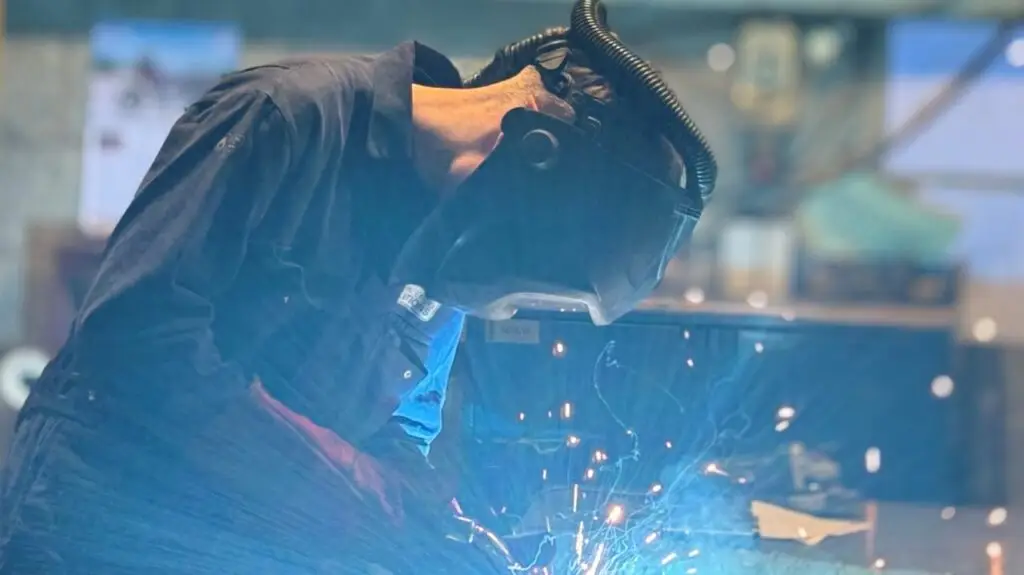
That’s as well as arranging media visits and helping young apprentices at Acres Engineering (overseen with such care by the firm’s HR and HSQE manager Alison Parker) prepare themselves for chatting with a radio presenter for the first time (which they did like pros).
I didn’t do an apprenticeship myself.
But talking to all these experts – from those undergoing an apprenticeship to people who have come out the other side and are now running a company – I feel I might have missed out.
From welding to finance to IT, it all sounds like a great way of getting qualifications and actually learning skills without having to pay for any of it.
(With my poor eyesight and lack of hand eye co-ordination I’d likely have been a menace as a welder, to be honest – but you know what I mean).
Every year National Apprenticeship Week gives businesses, training providers and learners themselves the opportunity to shout about this increasingly popular way of gaining skills.
That’s great for businesses. And it’s great for our job, too: helping companies who employ apprentices tell a story about the single biggest factor to any successful enterprise – their people.
Who, what, how, where, why and when
Famously all good news writing focuses on the who, the what, the how, the where, the why and the when.
Those of us who cut our teeth in a newsroom have had this drilled into us.
If a story doesn’t answer at least two of these in the first few words, you may as well pack your bags and go home because you can be certain your reader will have.
What does that actually mean?
It means this: when you’re telling a story about a business, you need to be clear which of these factors is the most likely to grab a reader’s attention.
As PRs, we also need to be clear on who that reader is depending on the publication. Are they a company director? Or a member of the public?
For example.
Sir Paul McCartney could open an envelope in the local area and we’d probably be interested. That’s because of who he is. And also where it happened.
A business you’ve never heard of which has invented a new way of travelling to the moon and back will be interesting. That’s because of what it is. And what sector it operates in.
Awareness raising campaigns like National Apprenticeship Week are great because they help businesses focus on the story of their ‘who’ and shout about their apprenticeship schemes in a natural way that at any other time of the year might struggle to gain headlines.
The week provides the focus – the ‘hook’ as we like to say in PR.
It shines a light on apprentices and means those editors with their busy email inboxes are much more likely to be interested in these stories during those few days then they are at other times of the year.
Raising awareness
It’s not just National Apprenticeship Week right now.
It’s also Children’s Mental Health Week. It goes without saying that as a mum of two myself, I don’t know what could be more important than that.
But how should we raise awareness of all the work going out there to help children manage their mental health?
It’s not an easy topic to talk about.
Not easy to illustrate, nor to demonstrate impact.
That’s why in terms of highlighting a project connected to children’s mental health, this week, too, has similar potential.
Let’s say you run a school.
You want to raise awareness of this extremely important issue and how it is affecting children in 2026. Perhaps you are running a valuable project helping children with their mental health and would like people to know about it so they follow suit.
Good PR practice would be to push the story about your project out during Children’s Mental Health Week so that editors are already primed to be prepared for stories of this nature.
What other awareness days are coming up?
There’s the big festival of lurve of course – Valentine’s Day, on February 14.
Maybe not an obvious one for most businesses but if you’re a restaurant it’s the perfect time to create stories about what you’re doing to advance the general cause of living happily ever after.
Pancake Day – always makes for good pictures. But at any other time of the year, who really cares about these flipping great treats?
Don’t think you have a story to tell? Harness the power of awareness days
Lots of business owners don’t think their business has a story to tell.
Yet they would love to see the impact that great storytelling will have on both their reputation and profit margin.
They’d love to get talked about like CEOs of major companies do, showing up in the media all the time to give their expert opinion.
Being aware of awareness days that are coming up on the calendar can be a brilliant way of getting started.
It’s a good way to tell different stories about your business, by making them naturally fit the news agenda of the day.
Running a science company? You don’t just need to wait for your next big breakthrough to get some PR. Awareness campaigns like British Science Week from March 6-15 are a great tool to get some publicity about the work you are doing.
Doing something sustainable? Shout about it on Earth Day (it’s in April).
Working in PR, we really enjoy digging out our clients’ stories – often those they didn’t know to tell themselves.
Because every business, every charity, every organisation, every school, has something to say.
The trick is getting people to listen. And that’s where we come in.
Want to know more about awareness days? Sign up to our Penguin PR newsletter via our website at www.penguinpr.co.uk, which has a handy monthly guide giving you the lowdown of what’s coming up on the news calendar.