One of the problems of history is that once the best-known stories become common knowledge, people can assume that there is nothing more to learn about them, writes Simon Burch.
And so, very often, the personalities involved in them become part of the furniture, and their stories stay stuck and fade over time.
Take Florence Nightingale.
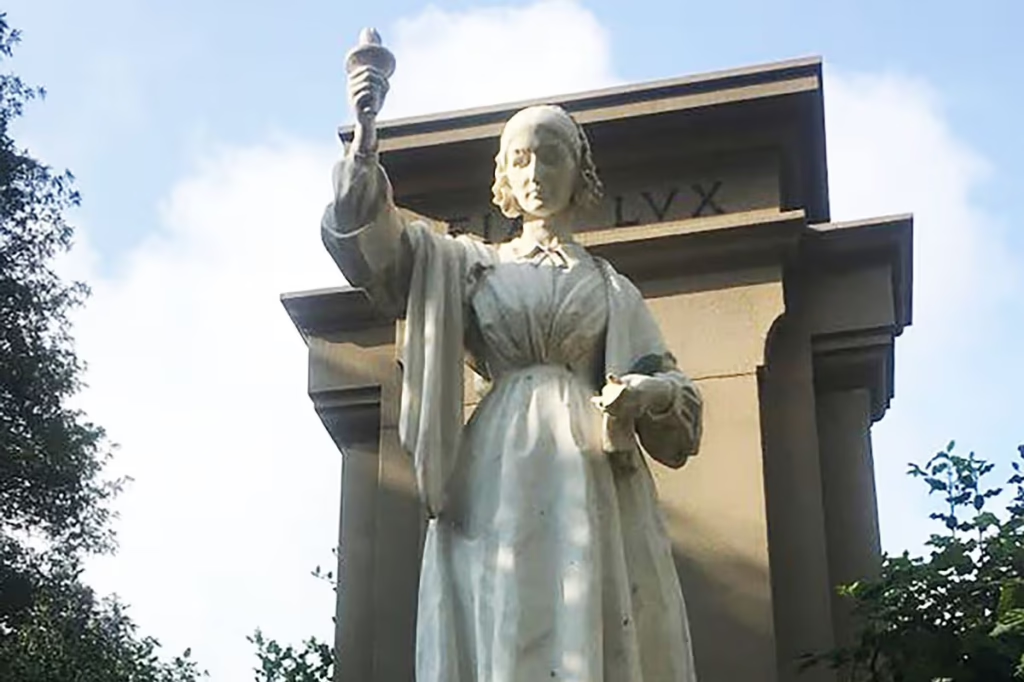
If you live in Derby, you (should) know plenty about her, not least because there is a statue to her – complete with obligatory lamp and pet owl – in London Road, outside the former DRI, now Wavenmere’s Nightingale Quarter development.
And, I’d hope, you’d know her story – how a young woman who grew up in Derbyshire (Lea Green) found fame while tending injured soldiers in the Crimean War in the 1850s and saved countless lives after realising that many of them were dying because of the hospital’s squalid conditions.
Then, on returning home, she set about pioneering a whole new approach to nursing and public health, saving even more lives and inspiring millions of people along the way, cementing her fame as the inspirational Lady with the Lamp.
Derby’s Florence Nightingale tributes
If Florence had wanted fame, a kind narrative and statues (there is one in London and three in Derby) then she can’t really complain.
However, it may well be that somewhere in the afterlife she has cause to grumble because, like so many characters in history, her fame is based on a tale that is only half of the story.
And, it turns out, her real gift to the world wasn’t just medical care but something even more profound – harnessing the power of data.
Florence Nightingale didn’t go to the Crimea because she was handy with a triangular bandage. It was she was a superb administrator, a sanitary reformer who had already worked in clinical settings and something of a maths nerd.
She had got the job through her family friend, the war secretary Sidney Herbert, who was under great pressure to reduce the number of deaths in the war hospitals.
Florence asked him personally to send her, and he did, and it was while she was geeking out on stats at her desk that she discovered that more soldiers were dying from disease contracted in the hospital than from injuries suffered on the battlefield.
A clear view showing the effects of dirt
As a believer in miasma theory – the idea that disease was transmitted via foul air – she set about convincing the powers that this was because their hospital was filthy, with dirty linen, unwashed hands, rotting matter close by and stuffy wards.
But how could she show them what the figures were showing her?
She knew that tables of numbers was a turn-off, so she created diagrams – infographics in today’s language – to bring the data to life through shapes and colours.
It was the dawning of the science of data visualisation, which, in today’s data-drenched world, is everywhere, thanks to graphs and pie charts and Venn diagrams, but wasn’t a thing back in the 1850s.
Florence made it a thing, and she presented it to Sidney Herbert and the government, and newspaper journalists, who shared her diagrams with the British public.
And it was their reaction to what the visuals were making clear – that their sons, fathers and brothers were dying needlessly – that forced a reluctant military and government to, quite literally, clean up their act.
A legacy is sealed for “The Lady With the Lamp”
This is why Florence Nightingale became hugely influential in her time and, even when she was confined to bed for 30 years due to illness, she could hold court with the leading legislators and public figures who came to her bedroom to visit her.
And the lamp? That was the work of the over-imaginative poet Henry Wadsworth Longfellow who, filled with the Victorian notion of sentimental heroism, immortalised Florence in his poem Santa Filomena as some kind of nocturnal, feminine and caring angel.
Which isn’t really what she was doing out in the Crimea.
But before we replace the lamps in her statues with spreadsheets, it’s worth noting that the theory that was right at the heart of her work to clean up hospitals – miasma theory – was, ironically, wrong.
Which means that her data wasn’t actually showing what she thought it was showing, and, in effect, was built on a false premise.
Disease spread through hospitals via germs from surgeons’ unwashed hands, not through the air – a finding that had been made earlier in history, in 1840s Vienna, by an obscure junior doctor called Ignaz Semmelweis.
Unlike Florence Nightingale, he lacked the social standing, contacts and ability to communicate his findings effectively and, despite his groundbreaking work, ended his days ostracised by the medical establishment, bitter, angry and in a Hungarian mental asylum.
And nobody knew what he’d discovered until after his death.
A lucky break but a mangled Victorian story
Florence, meanwhile, had struck lucky. Her zeal for cleanliness extended to insisting that everybody washed their hands and it was this, not the opening of windows to flush out the foul air, which did the trick.
Does this matter? Maybe not. Because Florence still performed a Victorian miracle and the science caught up with her methods in the end.
But what’s interesting is how her story has been mangled not by the passage of time, but by the way it was written in the first place – back to the myth of the Lady with the Lamp, a far more palatable depiction of a female in a medical setting for a Victorian public than a no-nonsense administrator.
And that it’s only now that we all use data and understand its role in our day-to-day world, that we can realise quite how amazing her work was, and that it’s her early ability to use data effectively, not holding up a lamp and being caring, that deserves to be her legacy.
Communication and contacts were the key
Plus, there is a PR lesson that we can throw into the mix – that it’s not what she knew that was important (because she was essentially partly wrong), but the fact she was able to communicate it clearly and creatively and, most crucially, to the right people.
And it was this combination that allowed her ideas to spread and to change the world.
All of which should be enough for Derby to use Women’s History Month to reappraise our three Florence Nightingale statues and our link to her incredible story – and reinvent her as a world-leading STEM pioneer.
This article was written by Simon Burch as part of our weekly blog series exploring the talking points in the news, our local community and the PR industry. But we write blogs for our clients too! If you would like to find out more about how we can help, contact us at [email protected]