
Derby engineering firm Whitehouse Construction has spoken of its local pride after it helped return a much-loved city landmark to its former glory – including its imperfections.
The company has just finished the painstaking restoration project to remove, renovate and then put back the 400m-worth of Grade II-listed cast iron Victorian bollards, chains and rails lining the pavement at the bottom of Duffield Road.
It took the firm nine months to carry out the work, which took place alongside its other projects to remodel the layout at Five Lamps and further down Duffield Road and Kedleston Road.
READ MORE: Major upgrade for one of Derbyshire’s most historic schools
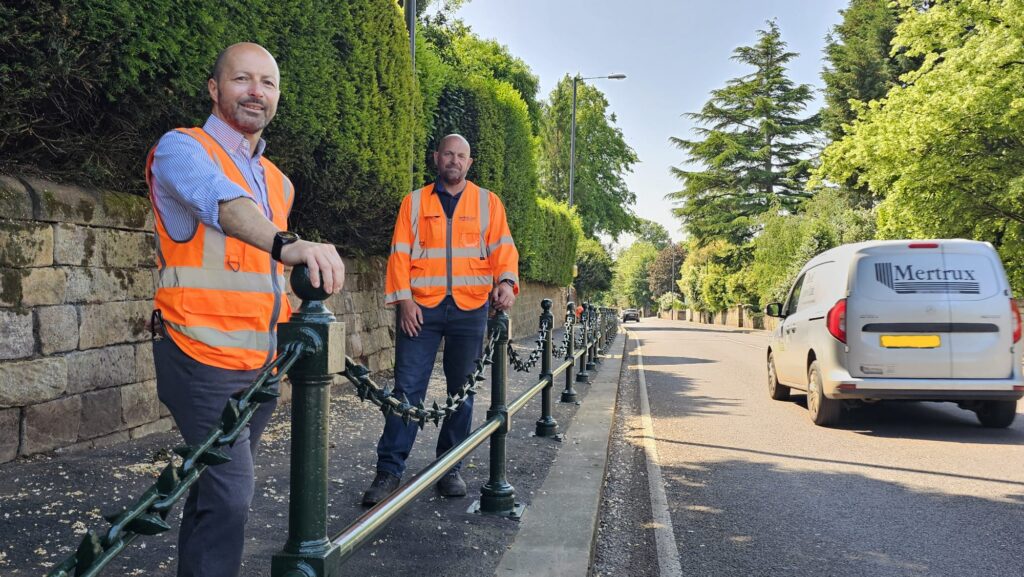
It involved removing every single one of the bollards – there are 166 in all – as well as the handmade spiked chains and the rails connecting them all together.
The metal work was removed and restored using traditional methods by Calibre Metalwork, a specialist firm in Stockport, which blast-cleaned every component to bare metal, repaired the ironwork where it had cracked or corroded with time and applied a fresh new coat of green paint.
Whitehouse also installed new base plates into the pavement ready for the renovated bollards to be fixed into, alongside putting right the Tarmac around the base of each one.
It also replaced or repaired damaged sections of the sandstone retaining wall.
The restoration was commissioned by Derby City Council as part of its wider Five Lamps junction improvement programme, with funding specifically provided by the East Midlands Combined County Authority to preserve the heritage ironwork.
The ironwork was originally cast around 1880 by local engineers Chartres & Sons as part of a project to widen Duffield Road in 1881, which resulted in a raised pavement on one side of the road.
Many of the bollards have been replaced over the years by other famous Derby foundries, including Derwent Castings and Browns Foundry Co and they have been protected as a listed building.
This listing means that the bollards, which are also contained within the Strutt’s Park Conservation Area, are recognised as being of special interest, meaning that the entire fabric of the structure, including materials, form and idiosyncrasies, have to be preserved.
It required Whitehouse to work alongside conservationists throughout the entire project, with strict instructions to ensure everything had to look exactly the same as it did when it was removed.
This meant the team carried out a thorough survey of the entire run of ironwork and number, photograph and document each one in meticulous detail, including its position, the angle at which it stood and the precise length and hang of every chain.
The result is a historic stretch of ironwork that once again looks pristine, albeit it is riddled with imperfections that date back to its original manufacture and installation nearly 200 years ago.
Richard Jamieson, Whitehouse Construction managing director, said: “Most people probably don’t realise it, but there is very little that is uniform about the bollards. They’re not equally spaced, and that means there aren’t equal drops on the chains.
“They’re not all plumb either. If you look carefully you’ll see that two of the bollards lean slightly over to one side because they weren’t put in properly, while there is one bollard that has a spike, unlike all the others, for some reason.
“As engineers, we’re used to precision in line and length, but we had to park all that, because we had to fix everything back exactly as it was. Every bollard, every chain and every rail is back exactly where it was to ensure that the railings are no different to before, warts and all.”
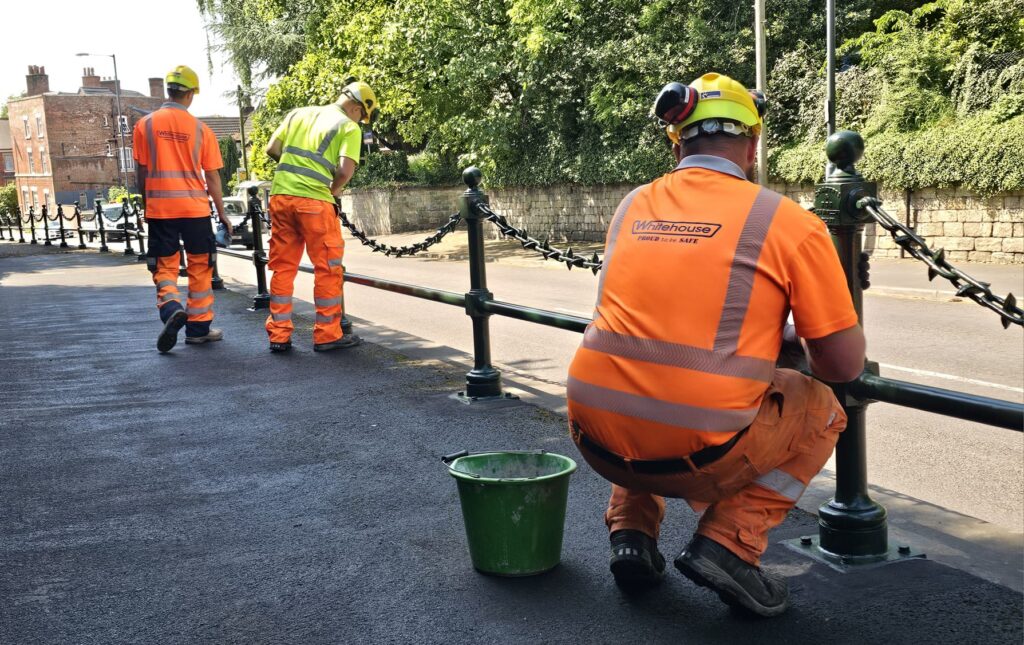
Hidden to passers-by, the company has fixed two brass plates to the base of two of the bollards, which will provide a record of the work for the next company which renovates the ironwork in the future.
Whitehouse has also installed two engraved stone plaques at either end of the railings in the pavement to mark the successful conclusion of the project, which will be officially commemorated at a ribbon-cutting ceremony taking place on May 28.
Richard added: “Achieving that took a huge amount of work and we were working against every instinct because we were essentially putting things back incorrectly, so that took getting used to.
“But in the grand scheme of things, when we step back and think about it there’s a real feelgood factor knowing that these bollards will be there for another 100 years and we’ve added another chapter to their story.”