
An Eastwood funeral firm unearthed a reminder of the town’s industrial past when it carried out a ground survey to ensure its expansion project can go ahead – and found a series of coal seams running beneath its car park.
Gillotts Funeral Directors discovered layers of undisturbed coal measuring up to half a metre deep during exploratory work carried out at the end of the month.
The work was commissioned as part of preparations for its planned extension into and renovation of the town’s former Victorian police station, on the corner of Nottingham Road and Oxford Street.
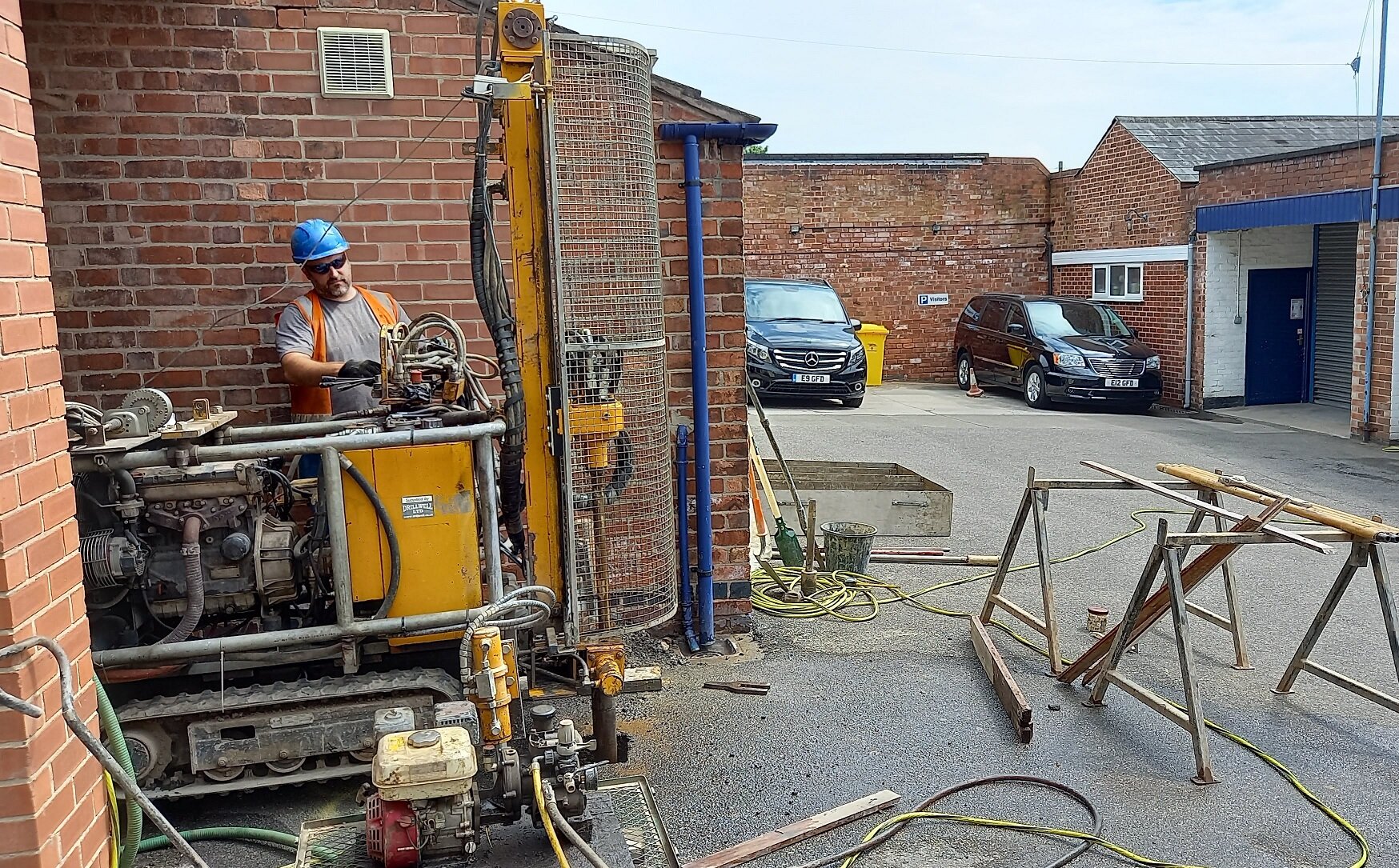
A survey being carried out of the ground beneath Eastwood funeral firm Gillotts Funeral Directors’ car park, which found evidence of a number of small coal seams, a reminder of the town’s industrial past.
Planners had asked the company to investigate in order to allay fears that any previous mining activity to extract coal below the surface could threaten the stability of the building’s foundations when work began.
Gillotts sank three bore holes in total, to a depth of 35 metres, bringing up a mixture of coal, sandstone, clay and mudstone to the surface.
Although one of the boreholes discovered no fewer than three seams of coal, the ground was intact, with no voids that would have indicated that the area has ever been mined and the workings abandoned.
As a result, Gillotts is looking forward to receiving planning approval for its renovation work, which will include a new main entrance to the combined properties and will begin next year.
Barry Hutsby, a partner in Gillotts, said: “Although everyone in Eastwood is aware of the town’s coal-mining history, it’s fascinating to see first-hand how seams of unmined coal still continue to criss-cross the town under our feet.
“Thankfully in our case, this seam was too small and presumably of insufficient interest for anybody to have set about mining it and so we can rest assured that the foundations of the old police building are secure.”

Barry Hutsby (second right), a partner Gillotts Funeral Directors, says that the coal find was a fascinating reminder of Eastwood’s coal-mining history, which ended when the Moorgreen Colliery closed in 1985.
Records show that coal-mining was first carried out in the Eastwood area some 700 years ago but reached its height in the 19th century with the opening of various collieries, operated by private landowners, around the town.
Helped by the arrival of the railways, Eastwood’s mines continued to grow until well into the 20th Century. However, dwindling coal stocks meant that the last colliery in the town, Moorgreen, which at its height had employed 1,300 men, closed in 1985, shortly after the end of the Miner’s Strike.